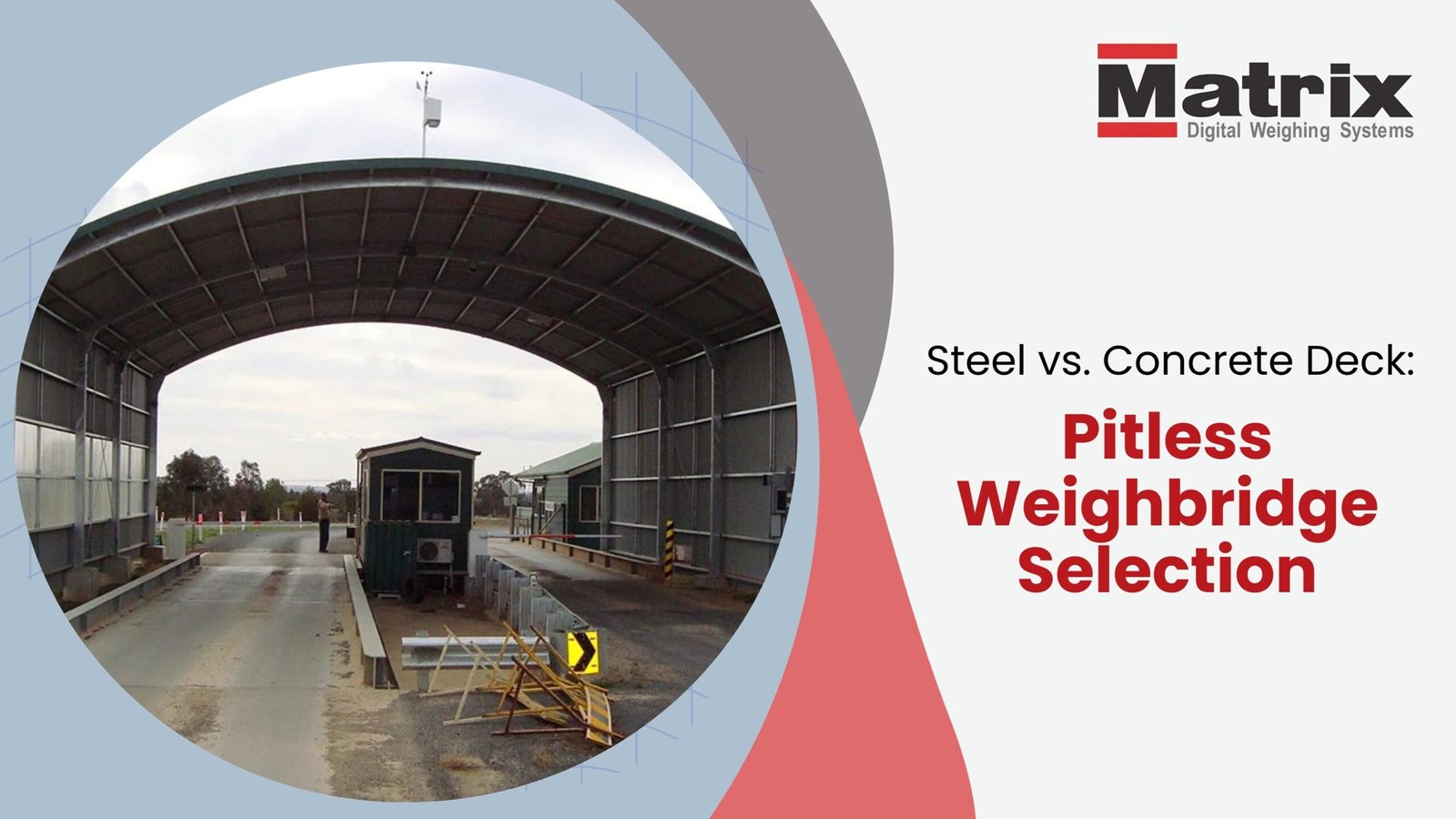
Steel vs. Concrete Deck: Pitless Weighbridge Selection
Introduction
Deck material determines how your pitless weighbridge performs over decades, but most buyers choose based on initial quotes without understanding long-term implications. Steel decks cost more upfront but relocate completely. Concrete decks minimize maintenance but lock you into permanent placement. The wrong choice creates maintenance headaches or stranded assets that can’t adapt to changing operations. This guide breaks down structural behavior, maintenance realities, cost factors, and site conditions that make steel or concrete the right choice. You’ll see specific decision criteria, lifespan differences, and total ownership costs that protect your investment.
Understanding Pitless Weighbridge Decks
Pitless weighbridges sit on surface-mounted foundations with approach ramps on each end. The deck supports vehicle loads and distributes weight to load cells mounted underneath.
Deck material affects installation time, maintenance requirements, and operational lifespan. Steel and concrete behave differently under repeated loading, temperature changes, and environmental exposure.
Why Deck Choice Matters
The deck isn’t just a platform—it’s a structural system that maintains measurement accuracy under stress. Deflection, thermal expansion, and fatigue patterns differ dramatically between steel and concrete.
These differences compound over 15-20 year operational periods into measurably different total costs and performance outcomes.
Steel Deck Construction
Steel decks use fabricated beams and checkered plates welded or bolted into modular sections. Load cells mount between deck modules and foundation supports.
Modern steel decks typically use 8-10mm thick plates with reinforced ribs underneath. Surface treatment includes shot blasting and epoxy coating for corrosion protection.
Steel Deck Advantages
- Installation Speed: Steel sections arrive prefabricated. Installation takes 3-5 days after foundation completion. No curing time required.
- Relocation Capability: Complete disassembly and reinstallation at new locations. This protects investment value when operations move.
- Maintenance Access: Bolted connections allow removal of individual sections for load cell service without cutting or breaking structural components.
- Weight Efficiency: Lighter decks reduce foundation requirements by 30-40%. This matters on sites with poor soil bearing capacity.
Concrete Deck Construction
Concrete decks incorporate reinforced RCC slabs cast on-site or assembled from precast sections. Load cells embed in concrete pockets or mount beneath the slab.
Construction requires formwork, reinforcement placement, concrete pouring, and 21-28 days curing before load cell installation begins.
Concrete Deck Advantages
- Structural Rigidity: Monolithic concrete distributes loads uniformly. This reduces corner load errors that affect measurement accuracy over time.
- Surface Durability: Concrete resists abrasion from repeated truck traffic better than coated steel. The surface doesn’t dent or deform under point loads.
- Minimal Maintenance: No coating renewals required. Properly constructed concrete decks operate for 20-25 years with only periodic inspection and minor crack repairs.
- Environmental Resistance: Concrete doesn’t corrode. Coastal locations with salt air and monsoon-heavy regions avoid the rust concerns that plague inadequately maintained steel decks.
Performance Under Load
Deflection Characteristics
Steel decks flex under load—typically 3-5mm at center span for 60-ton capacity platforms. This flexing returns to zero when vehicles exit.
Concrete slabs deflect minimally—under 1mm for equivalent capacity. Less deflection means more consistent load cell readings across varying traffic patterns.
Here’s the uncomfortable reality: steel deck accuracy degrades faster in high-throughput operations. Fatigue cycles accumulate in bolted joints and welded seams, creating permanent deformation that affects corner load performance.
Temperature Effects
Steel expands 12mm per 10-meter length for every 30°C temperature change. Bolted joints accommodate this movement, but thermal cycling stresses load cell connections.
Concrete expands half as much—6mm per 10 meters. Lower thermal movement reduces stress on load cell mounting points and maintains calibration longer between service intervals.
When Steel Makes Sense
Choose Steel Deck When:
- Project duration under 10 years or relocation is likely
- Installation timeline is critical to project schedules
- Site soil conditions limit foundation depth
- Modular expansion might be needed later
- You need maintenance access that doesn’t involve breaking concrete
Steel’s upfront cost premium pays back through flexibility. Operations that might relocate or expand protect investment value through reuse.
When Concrete Delivers Value
Choose Concrete Deck When:
- Site ownership is permanent with 20+ year operational plans
- Traffic volume exceeds 200 vehicles daily
- Environmental exposure includes coastal salt air or industrial chemicals
- Maintenance resources are limited
- Extremely heavy loads (100+ tons) require maximum structural rigidity
Concrete’s maintenance-free operation compounds savings over decades. The initial time investment pays back through operational simplicity.
Site Conditions That Decide
Climate and Environment
Monsoon-heavy regions create rust risk for steel decks. Coastal operations within 50km of seawater need aggressive coating maintenance on steel or face premature failure.
Industrial environments with chemical exposure attack both materials differently. Acids damage concrete. Certain chemicals accelerate steel corrosion. Match deck material to your specific exposure.
Traffic Patterns
Mining operations with overloaded trucks create fatigue stress. Steel’s flexibility absorbs these stresses better initially but degrades faster long-term. Concrete cracks under severe overloading but maintains accuracy longer under legal loads.
Seasonal operations with 4-6 month annual use favor steel. The ability to relocate to protected storage during off-seasons extends total lifespan dramatically.
Cost Reality Check
Steel decks cost 15-25% more than concrete for equivalent capacity. Installation labor costs similar amounts—concrete needs more time but steel requires crane rentals.
Maintenance costs flip this equation. Steel needs recoating every 8-12 years at 10-15% of original deck cost. Concrete requires minimal expense beyond periodic inspection.
Over 20 years, total ownership costs equalize when you factor in steel’s relocation value. Concrete costs less for truly permanent installations. Steel wins when any possibility of relocation exists.
FAQs
Q: Can I upgrade from steel to concrete deck later?
A: No. The foundation and load cell mounting system differs between types. Deck material choice is permanent unless you rebuild completely. Choose correctly initially.
Q: How long do steel deck coatings actually last?
A: Quality epoxy coatings last 8-12 years in moderate environments. Coastal or chemical exposure reduces this to 5-7 years. Budget for recoating as ongoing operational cost.
Q: Does concrete deck limit load cell replacement?
A: Load cell access depends on design. Quality concrete weighbridges use mounting pockets that allow load cell removal without breaking concrete. Poorly designed systems require jackhammering for service.
Q: Which deck type maintains accuracy longer between calibrations?
A: Concrete decks typically maintain calibration 15-20% longer due to minimal deflection and superior thermal stability. Steel decks in high-volume operations need more frequent verification.
Q: Can pitless steel weighbridges operate in areas with poor drainage?
A: Yes, better than concrete. Elevated steel decks provide ventilation underneath that helps water evaporate. Concrete collects moisture that can damage load cells and corrode foundation elements.
Conclusion
Steel decks deliver flexibility and fast installation at the cost of maintenance attention. Concrete provides structural permanence and minimal upkeep but locks you into fixed placement. Choose based on operational permanence, traffic volume, environmental exposure, and relocation possibility rather than initial price differences.
Matrix Weighbridge manufactures both steel and concrete deck pitless weighbridge systems engineered for Indian operational conditions. Our designs optimize deck material choice for your specific site requirements, traffic patterns, and operational lifespan.
Ready to specify the right deck material for your pitless weighbridge? Visit matrixweighbridge.com to review steel and concrete options, compare technical specifications, or request a site assessment and material recommendation from our engineering team today.